
Moonlight Upon Our Given Fates

It should not be controversial to acknowledge that contact with, and incorporation into, expanding colonial empires produces a long inheritance of generational trauma/dysfunction in indigenous populations. I put that broadly as possible so that it may contain any political meaning you require it to. Of course, we will have our own opinions, but if they’re opposed on this matter, then I expect the difference will be profound. But that is just the nature of the Aboriginal Question in Australia. It alarms people. And because most White Australians tend to think of Indigenous Australians as somehow belonging to our responsibilities, (and this can well be expressed as a long list of colourful resentments), we are generally invested in their outcomes.
In 2007, following the release of a report into child sexual abuse in Northern Territory Aboriginal communities, the Howard government introduced a sweeping Commonwealth package that banned alcohol in prescribed Aboriginal communities and town camps, and compulsorily leased Aboriginal townships via legislation that partially suspended the Racial Discrimination Act 1975. Despite legal challenges, and popular/academic controversy, the measures were retained; and, to the extent any reform sought to address the openly “racist” posture of the policies, they were simply adapted into different program measures, implemented under different names, and burdened by cumbersome and ineffective “community consultation.”
What’s interesting is that no subsequent government has found it within their capacity to end these measures altogether. These are literal two tier policing methods. Aimed squarely at Aboriginal communities. And virtually no indigenous governing body is calling for that, either. (Nor are their activist foot soldiers, in most cases). This goes the same as it applies across the nation. In the state of Queensland alcohol carriage-limit restrictions apply in 15 discrete Aboriginal and Torres Strait Islander local government areas; and the number is closer to 30 in Western Australia.
It’s clear to everyone that something needs to be done. By which I mean: at all times! That something could simply be the existing status quo, or its inevitable, countless “refinements,” or something more overreaching. I’m not arguing in favour of anything here. I am simply highlighting a fact that I find to be quite absurd—not insofar as I find it difficult to believe, but that no part of the public conversation seems capable of acknowledging it: the Aboriginal Australian cannot be trusted to determine his own affairs.
Maybe you don’t like reading that. It’s not something I take pleasure in stating. But it is the clear and formal position of the Australian and state governments. And it always has been. So I would urge people to open themselves up to the conversation in a way they have been trained to think of as regressive.
In 1842, Herman Melville spent four months living with the natives on the island of Nuka Hiva, and later pontificated upon the shared fate of the world’s Native in his first book Typee:
“Ill-fated people! I shudder when I think of the change a few years will produce in their paradisaical abode; and probably when the most destructive vices, and the worst attendances on civilization, shall have driven all peace and happiness from the valley, the magnanimous French will proclaim to the world that the Marquesas Islands have been converted to Christianity! and this the Catholic world will doubtless consider as a glorious event. Heaven help the ‘Isles of the Sea’! — The sympathy which Christendom feels for them, has, alas! in too many instances proved their bane.”
Let savages be civilized, but civilize them with benefits, and not with evils; and let heathenism be destroyed, but not by destroying the heathen. The Anglo-Saxon hive have extirpated Paganism from the greater part of the North American continent; but with it they have likewise extirpated the greater portion of the Red race. Civilization is gradually sweeping from the earth the lingering vestiges of Paganism, and at the same time the shrinking forms of its unhappy worshippers.”
The modern reader naturally squirms at Melville’s candour. But, equipped with his relentless humanity, Melville sees the world from all sides, he finds the heart of men, and he understands that there are forces of nature which are born from man’s own hands, and yet take their most dangerous forms outside of them. It is clear that he believes the endeavour of elevating our fellow man is a noble one. Except that he asked the question so long ago that no one would dare to ask now, despite it being more important than ever: “why can’t it be done graciously?”
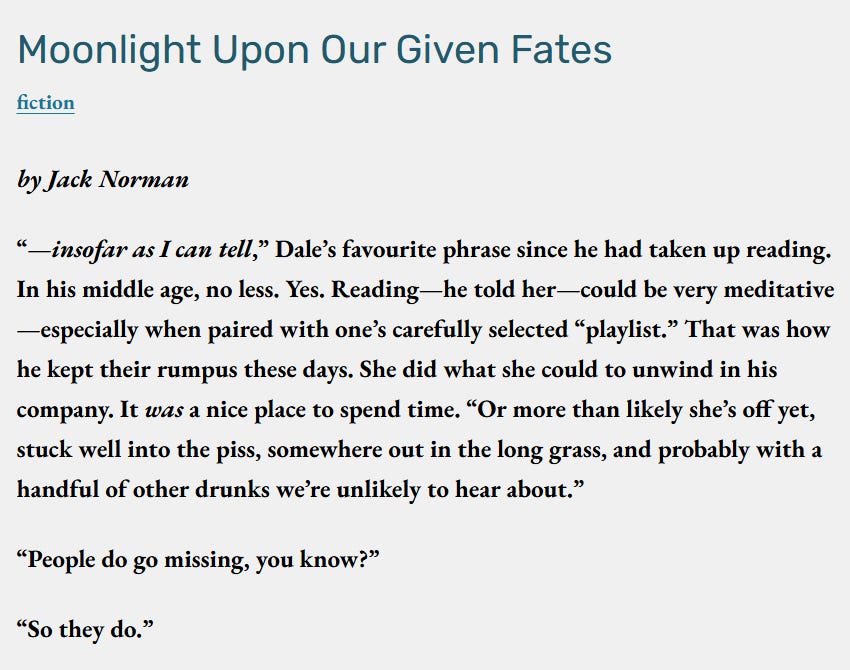
I wrote Moonlight Upon Our Given Fates in March 2026 as a prospective entry to the Furphy Literary Award’s open short story competition. The theme was: “Australian Life in all its diversity.” (Which, although perfectly in keeping with the theme, I’m sure would have horrified the panel). But the word limit was 5000 words and it became clear to me that the story would exceed this. (And, later, once it found its home at The Borough, the theme of the upcoming issue was/is: “Tradition.” Which is just as, if not more, suitable). I wrote the story as a native of North Queensland familiar with the behavioural/bureaucratic dynamics of the local indigenous population and the broader population. At risk of “spoiling” the story, I won’t say much more, but suffice to say that my sympathies lie with the vulnerable members of Townsville’s itinerant indigenous community. The women and the children who are subject to some of the worst outcomes of Aboriginal life quality.
In my story, it is an adult woman who is the centre of the reader’s concern. “Roslyn Cobbo.” But, of course, “the truth is stranger than fiction;” or, as I more intend to say: it is much sadder, and much more confronting, than anything we can imagine ourselves… In April 2026, a five-year-old Aboriginal girl was abducted from a town camp on the outskirts of Alice Springs. It was clear to everyone that her abductor was an extended family member, and repeat criminal offender who had been released from prison just days earlier. Just like my character, Roslyn Cobbo, the young girl was the subject of a national MISSING PERSON saga played out in the media—(and I must admit to feeling very sick at the idea that some “dark” circumstance I had contrived for the purpose of a pithy little story was now being played out upon the tiny fate of that little girl)—and, sadly, it seemed that she had been dead all along.
The story itself examines the distant relationships between all people, including husbands, wives, friends, colleagues, “White fellas” (though I’ve never ever used that term), and “Black fellas” (same goes). So it is not fair to dedicate it to the memory of that little girl, because it is not sufficiently “about her.” But there is something now forever in my heart that will be searching for her. Flannery O’Connor says that the reason you tell a story is because a simple statement will always be inadequate to your meaning. Necessarily, then, that meaning must contain contradictions, obfuscations, uncertainties. Because no point of view is complete without them. So I can say that, hopefully, the story makes no single thrust on any issue… —But I can say this, as a sort of general feeling, forgetting the sanctity of art for a moment: I wish someone would have done something to help that poor little girl—or little girls like her who are still alive—and I really don’t care how drastic that something needs to be.
(And lastly on that. It later emerged the little girl had been the subject of six prior child protection notifications, which prompted the Northern Territory government to stand down three child protection staff. The minister expressed concern that workers may have been reluctant to remove children from Aboriginal families, as they are always operating under the carefully legislated context of the Stolen Generations, which basically results in grading the safety and wellbeing of indigenous lives on a curve, and, more flatly, in inaction. Cowardly inaction, if you ask me. But they all. And we all. Encourage it).
I could lay out my final point in my own words, but it has been written in the clearest terms already, so why bastardise it?
… there’s a discussion about David Malouf and Remembering Babylon, and about how that book deals with the political without having a fixed conclusion on the politics. It’s rather a literary exploration. The idea of “moral imagination” is useful in this regard (Joshua Hren is all over this, essay linked in comments). Good writing shouldn’t draw moral conclusions, but should imaginatively examine moral questions. What happens if Raskolnikov murders this guy? What are the moral consequences? I like what Gidé had Edouard write in his journal (in The Counterfeiters):
Nov. 9th.—There is a kind of tragedy, it seems to me, which has hitherto almost entirely eluded literature. The novel has dealt with the contrariness of fate, good or evil fortune, social relationships, the conflicts of passions and of characters—but not with the very essence of man’s being.
And yet, the whole effect of Christianity was to transfer the drama on to the moral plane. But properly speaking there are no Christian novels. There are novels whose purpose is edification; but that has nothing to do with what I mean. Moral tragedy—the tragedy, for instance, which gives such terrific meaning to the Gospel text: “If the salt have lost his flavour wherewith shall it be salted?”—that is the tragedy with which I am concerned.
The Borough is an annual publication that publishes in partnership with English Speaking Union (Victoria Branch). The theme of the 2026 issue will be ‘Tradition’, which may be interpreted as including all life rhythms, verse rhythms, national, cultural, religious and family traditions, and of course literary tradition.
My story can be read here.
😴😴😴
Beautifully said, and thanks for including that post of mine. That story from Alice is heartbreaking. To think the organisation responsible for the town camp from where she was taken banked $70m in grants. https://www.theaustralian.com.au/nation/indigenous/alice-springs-town-camp-squalor-despite-millions/news-story/13d53be0767d20c40f800ff07fe3a553